Sunday, June 7, 2009

Unfortunate model name for a car

image

I should be finishing up something else but I realized I have not posted anything since Wednesday… Well, that simply won’t do so here it goes…

I dived into the stack of random pictures I took and came up with this one which I think you might find to be interesting.  This tiny “car/truck” is produced by Daihatsu and its model name, as proudly shown in the front of the vehicle is “Midget II”. Needless to say if they were to export this model to, say, the US, they might have to rebrand the vehicle (which would not be the first time of course). Car manufacturers, and I don’t mean just the Japanese ones, regularly use different names for models that would be sold in different regions of the world. It’s just I have never seen quite a name like this being used in any region.

It turns out there was a “Midget” as well – which was the original model. Wikipedia has a lot of information on the models with more pictures.

Wednesday, June 3, 2009

The Hydrangeas

DVC00001.JPG

Hydrangeas are beautiful flowers native to parts of Southern and Eastern Asia. Apart from looking so pretty themselves, they have one interesting property. Their color changes based on the acidity/alkalinity of the soil they are planted in (for example from blue to pink). As the rains can change just that, these flowers are sought after during the rainy seasons in Japan. Some cities like Kamakura (鎌倉市) are particularly famous for their hydrangeas. I snapped this picture when I was in Roppongi of all places. On my way to the National Art Gallery/Museum I saw these hydrangeas in front of an apartment building and took their picture with my phone (sorry for the quality). I hope this year I will be able to visit Kamakura during the rainy season with my actual camera and take some close ups of these very beautiful flowers.

Monday, June 1, 2009

Sumo (conclusion)

It’s rain pretty much every other day for now and with work piling up I don’t get much of a chance to breathe but I should update the blog and finally finish up the Sumo story, shouldn’t I? Let’s see… Where was I?… Ah, yes…

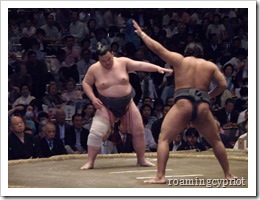
P5240174 P5240175

Let’s start with various gestures. As I mentioned before there is a big ceremonial component to sumo and you can clearly see that when watching the competition. Certain gestures are for expressing a message, like showing open palms indicate the willingness to engage in fair-play. Other gestures are related to showing respect to the sport and the ring. For example, the wrestlers need to “purify” themselves and the ring when enter the ring – even if they only left the ring for a second. Talking about showing respect – the wrestlers are ranked not just based on their performance but their respect and sportsmanship as well. The “wins” of course matter a lot but wrestlers who are deemed to be not “behaving well” are usually punished by the national sumo committee.
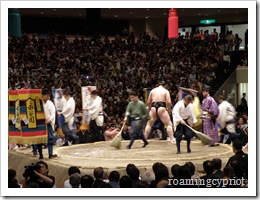
P5240196 P5240197

There are no advertising billboards in the arena which is a huge contrast to pretty much any other professional sport. Given that it attracts huge crowds and is broadcasted nationally, one might find that a bit strange. Well, not to worry – there are ads but they are a bit hidden under a “traditional” cover. Before popular wrestlers’ bouts, as the wrestlers are warming up, men carrying advertising signs get in the ring. Each man carries a single banner containing a single ad and the more popular the wrestlers are, more signs there are. Each banner also signifies a set amount of reward money (about $500) to the winner so, for example, if there were 10 banners, the winner would receive an extra $5000.
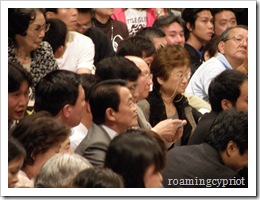
P5240195

Let me finish up with this picture I snapped of the Japanese Prime Minister, Aso Taro. He was there to give the final trophy to the winner. I heard that even though prime ministers are supposed to give the final trophy they rarely show up to do so. This time, the elections being so close, this was a good photo-op for the PM and he did not miss it. Well, I am not complaining. I got the chance to see him in person and snap a photo. Not too shabby I would think – especially given that he looks almost certain to lose the upcoming elections…

Friday, May 29, 2009

More on Sumo

P5240182The competition itself is a pretty long event. It takes place over the course of 15 days and each competitor competes only once on a given day. There are many, and I mean many competitors, divided up into different classes. At the top of the class, and competing towards the end of the day (close to 6 pm) are the Yokozuna – only one or two Sumo wrestlers can have this title at a given time. Other wrestlers compete earlier in the day, based on their ranks. Given that each match takes about 6 minutes (5 minutes of which is preparation time and the wrestlers sizing each other up) and that each day of the competition starts at 8 am and lasts until 6 pm, one can make an educated guess about the size of the competition.

  P5240183The top 5 class of wrestlers start competing after 3:00 pm which is when most of the crowd comes in. The scoreboards in the arena (the white strip in the picture above) lists each match with the winner highlighted with a red line. The current match has two red lines, one of which disappears after the conclusion of the match.  Between matches there can be other short events like the Yokozuna performing a traditional ceremony or all of the wrestlers in the top category coming out to be introduced. One interesting thing to note is that the wrestlers are divided into two groups – east (東) and west (西) but these merely denote which side of the arena they will start from (of course they also limit who can compete against who since two people cannot start from the same side). People do not cheer for the groups but rather for their favorite wrestlers. As the day goes on and the ranks of the wrestlers increase the amount of passion and number of people screaming the wrestlers’ names also increase.

P5240199

Even though Sumo is the Japanese national sport, today there are many “foreigners” competing in the sport – quite successfully too I might add. For example both of the “Yokozuna” are actually from Mongolia and in the top two classes of wrestlers the number of Japanese wrestlers is in the minority. In the top classes of Sumo one can see wrestlers from Mongolia, Bulgaria and even Estonia. Of course all of these wrestlers adopt a Japanese name (the names of Sumo wrestlers are special in Japanese. They are not names used by any Japanese person who is not a wrestler himself. This is a bit similar to how a priest has to change his name if he is chosen to be the Pope) so it is a bit difficult – ok, impossible - to guess where they are from just based on their name.

Ok there is still more to come and it looks like this will be a 3 parter… Hey it is almost 1 a.m. in Tokyo and I have work tomorrow. Time to say good night!…

Tuesday, May 26, 2009

Sumo – Summer Tournament Finals

P5240169As I mentioned before I was lucky enough to be invited to the day of the tournament finals by my Japanese teacher Ms. Uchida and I thoroughly enjoyed the watching the matches, listening to the crowds reactions,… the whole experience. I can wholeheartedly recommend it to anyone and everyone who may be in Japan during any of the tournaments. If you are lucky you might see the emperor (he shows up for 1 of the 15 days of the tournament though no one knows beforehand which day, I am told) or the prime minister (like on Sunday ;)). I am getting ahead of myself, let me take a step back and try to cover this in a bit more chronologically proper fashion. This is likely to be a multi-part deal as well since well, I am lazy :P

P5240168 So, let’s get started. The big Sumo tournaments in Tokyo take place in Ryogoku Kokugikan (両国国技館) which is, well, in Ryogoku. Getting there is pretty easy – make your way to Ochanomizu using either Chuo Line or Yamanote Line. From there on, it is just 5 minutes on Chuo-Sobu Line (中央総武線). The station itself is pretty small but you immediately know you are in the right place since you can see the tournament hall as soon as you get off the train and it is impossible to miss the huge posters of famous Sumo wrestlers inside the station. The tournament hall is very close – about 30 seconds on foot. There are a lot of signage; not that you would need it though. On Sumo days you just need to follow the stream of people to get you there.

When you get in you show your ticket and they point you to a little “store” inside with a number matching the back of your ticket. These little “stores” are basically pickup points for food and drinks that are included with the ticket. Inside, ticket holders, save for the last minute buyers who don’t get to pick a reserved spot, each get a little square of their own, with enough size to fit four tightly packed people. In fact, all tickets correspond to one of these squares and they are sold as a set of four. Well, I will end this post with a panorama of what I saw when I walked in. I think it gives some idea as to the atmosphere inside. To be continued in the next post in a couple of days :)

OLYMPUS DIGITAL CAMERA

Saturday, May 23, 2009

Invitation to Sumo

roamingcypriot

I just wanted to drop a line about the invitation I got from my Japanese teacher, Ms. Uchida, to the final day of the Summer Sumo Competition. I will be attending it tomorrow and I will be sure to take a lot of pictures to post here. It should be a lot of fun. I watched sumo on TV before but I expect the experience to be quite different in person…

Tuesday, May 19, 2009

The song that just got stuck in my head

J-Pop, Japanese Pop Music, is pretty popular in Anime circles as well as in a lot of Asian countries and one can try to keep up with all the new Anime songs or try to follow the Japanese Billboard charts online but I think nothing quite matches the exposure one gets from living in Japan. One not only can hear about the chart topping songs online or on TV but you might also hear something completely unexpectedly and fall in love with it instantly. Case in point – the song that plays as the credits roll for 婚カツ – a new, very popular Japanese TV drama that I started watching from the first episode (it’s on the 5th episode as of now). I finally found a video of the credits with English subtitles so I finally get the song. The lyrics are pretty cute and the song has a nice feeling to it (though granted, reading the lyrics does change the perspective one would have about the content when oblivious to the language.) The song also goes really well with the subject matter of the series. I read that the song itself is actually a “re-interpretation”/cover of a song of the same name - “Wedding Bell”. This new version is by the Japanese duo, Puffy and I just can’t get it out of my head….